Glossary

Glossary

Plain-language definitions of the terms we use in reports: purity, dose accuracy, COA integrity, and the lab methods behind them.

Filter by group:
# A B C D E F G H I L M N O P Q R S T U V W
174 terms
A

Accelerated approval

An FDA pathway granting approval on an intermediate endpoint, on condition that a confirmatory trial follows. It is an approval, but a conditional one.

Actin sequestration

Binding free actin so it cannot assemble into filaments, which influences how cells move and reorganize. The described mechanism of thymosin beta-4 and of the TB-500 fragment.

Activin

A signaling protein in the same family as myostatin, also bound and neutralized by follistatin.

Acylation

Attaching a fatty acid chain to a peptide, usually to make it last longer in the body. Semaglutide and tirzepatide both use it.

Adulterant

A substance present in a product that should not be there, whether added deliberately or introduced through contamination or poor process control.

Amino acid

The building blocks of peptides and proteins. The order in which they are linked is the sequence.

Amylin

A hormone released alongside insulin, involved in satiety and stomach emptying. A separate pathway from the incretins, which is the stated rationale for combining the two.

Analog

A modified version of a molecule, altered to change how it behaves, for example how long it lasts in the body.

Approved supply chain

The manufacturing and distribution route that a drug approval actually covers. Material sold outside it is not the approved product regardless of what the label says. This is the distinction between an approved medicine and research-market material carrying the same molecule name.

Area normalization

Calculating purity by measuring each peak's area as a proportion of the total peak area. The convention for peptide purity figures.

C

C-terminal

The other end of the chain, conventionally written last.

Cardiolipin

A lipid in the inner mitochondrial membrane, essential to how mitochondria function. Abnormalities in it underlie Barth syndrome, the approved indication for SS-31.

Case report

A published account of what happened to a single patient. It can flag a real safety signal, but on its own it cannot establish that the compound caused what was observed.

Category 1, Category 2, and Category 3

Interim FDA classifications for nominated bulk drug substances. Category 1 substances may be used in compounding while under evaluation; Category 2 substances have identified safety concerns and may not; Category 3 covers substances nominated without adequate supporting information. Removal from Category 2 is not an approval.

Cathelicidin

A family of host-defense peptides found across many species. Humans express only one, released by cleavage from a precursor protein.

Cationic peptide

A peptide carrying a strong net positive charge. Highly basic peptides adsorb readily to glass and plastic and can tail on standard reversed-phase columns, so a generic peptide method should not be assumed suitable without demonstrating retention, peak shape, and recovery for that specific molecule.

Chain of custody

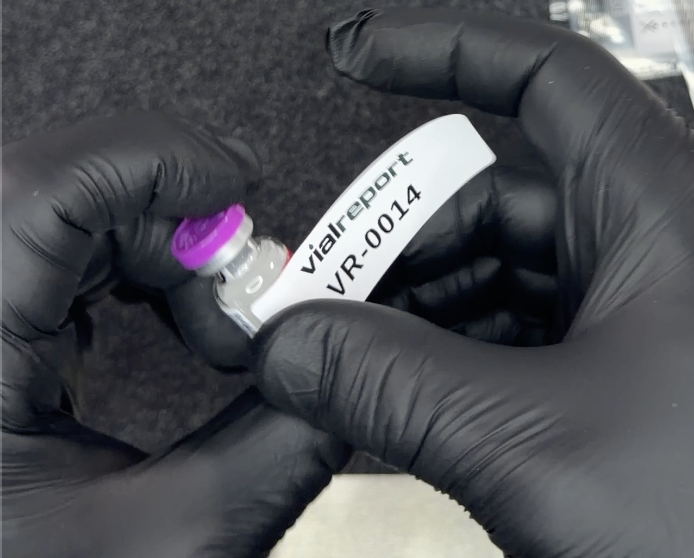
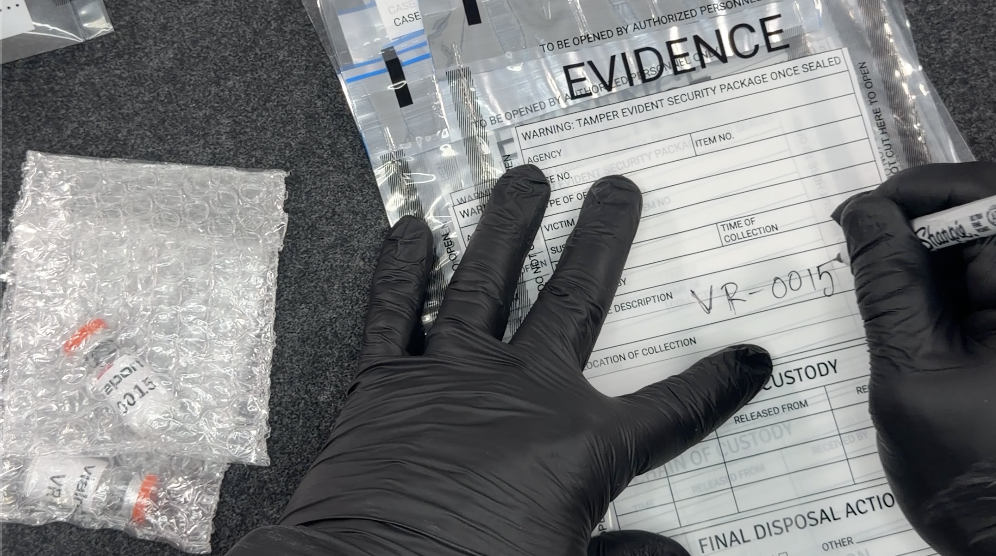
The documented, photographed record of a sample from the moment it arrives to the moment it is handed to the laboratory, including temperature readings at receipt, in storage, and at open.

Chromatogram

The output of a chromatography run: a graph of detector signal over time. Each peak is a component of the sample.

ClinicalTrials.gov and NCT number

The public registry of clinical trials and the identifier given to each one. A registered trial can be looked up, including whether it was completed or quietly abandoned.

COA

Certificate of analysis. A document stating what a laboratory found in a sample. A vendor-supplied COA is only as trustworthy as the laboratory that produced it and the batch it actually corresponds to.

COA Accuracy

How the numbers on a vendor's certificate compare to what our laboratory measured on the vial we bought. Content is compared to what the certificate itself claims, not to the vial label, because measured against label is Dose Accuracy and is already scored. Reported as a row on the scorecard, free on every report, and never part of the 0-to-100 score.

COA Integrity

Our umbrella term for two separate assessments of a vendor's certificate: COA Accuracy and Vendor Certificate Review. Both are reported beside the grade, never inside it, and they are kept under two names because they can point in opposite directions on the same vial.

Compound page

A reference page for one compound: what it is, what the published research has studied, and its regulatory status, plus every report we have published for it.

Compounding

The preparation of a customized medicine by a pharmacy for an individual patient. A different activity from manufacturing or from laboratory testing.

Counterion

The ion paired with a peptide in its salt form, commonly acetate or trifluoroacetate. Part of what makes salt form matter.

Cross-contamination

Material from one production run appearing in another, usually through shared equipment that was not adequately cleaned.

Cyclic peptide

A peptide whose chain is joined into a ring. It behaves differently from a linear peptide of the same sequence.

G

Ghrelin receptor (GHS-R1a)

The receptor ghrelin acts on. Ipamorelin, GHRP-2, GHRP-6, hexarelin and MK-677 all act here, which is why they are grouped together despite being chemically unrelated.

GHRH

Growth hormone-releasing hormone. The body's own signal telling the pituitary to release growth hormone. Sermorelin, CJC-1295 and tesamorelin are all analogues of it.

GIP

Glucose-dependent insulinotropic polypeptide. The other incretin. Tirzepatide acts on this and GLP-1 together.

GLP-1

Glucagon-like peptide-1. An incretin hormone affecting insulin secretion, stomach emptying and appetite. Semaglutide is an analogue of it.

Glucagon

A hormone that raises blood sugar, broadly opposing insulin. Retatrutide adds activity here on top of GLP-1 and GIP.

Glycosylation

Sugar groups attached to a protein. Varies with how the protein was produced, and complicates mass-based identification.

GMP

Good manufacturing practice. A regulatory framework for manufacturing quality. Frequently invoked in vendor marketing and rarely substantiated in this market.

Grade suppression

When identity is not confirmed, no grade is published at all: no letter and no number. A vial that is not the labeled compound has nothing coherent to grade, so the measurements are published as raw values instead.

Graded sample

A sample that received a quality grade. Samples that failed identity are excluded from this count, because they were never gradeable.

GRF 1-29

Another name for the first 29 amino acids of GHRH, the portion carrying its activity. Sermorelin is that sequence unmodified; Mod GRF 1-29 is a modified version of it.

Growth hormone (GH)

A hormone released by the pituitary that drives growth and influences metabolism and body composition. Many compounds in this library act on the systems controlling it rather than being it.

GSH and GSSG

The reduced and oxidized forms of glutathione. Two reduced molecules join to form the oxidized disulfide, and the two interconvert, so a material can shift between them after manufacture without anything having gone wrong. A single purity figure does not describe a material that exists in two interconverting forms; a meaningful result states which form was quantified.

I

ICP-MS

Inductively coupled plasma mass spectrometry. The standard method for measuring heavy metals.

Identity gate

Identity is checked before anything else, and it decides whether a grade appears. It is not scored, because a compound either is or is not what the label says.

IGF-1

Insulin-like growth factor 1. A hormone made mainly by the liver in response to growth hormone. Much of what growth hormone does downstream, it does through IGF-1.

Immunoassay

A test using antibodies to detect a specific substance. The fentanyl screen is an immunoassay.

In vitro

Research done in cells or tissue in a dish, outside a living organism. A result in vitro is a starting point, not evidence that something works in a person.

In vivo

Research done in a living organism. In this market that usually means rodents.

Incretin

A gut hormone released after eating that influences insulin release. GLP-1 and GIP are the two that matter in this library.

Independent replication

A finding reproduced by researchers unconnected to the group that first reported it. Regulators and drug developers weight replication more heavily than the original finding, and it is scarce across much of the research-peptide literature.

Indication

The specific condition a drug is approved to treat. Approval attaches to an indication, not to a molecule in general.

Intermediate endpoint

A measure believed to predict a real clinical benefit, used as a stand-in when the real outcome would take too long to observe.

Investigational

In clinical trials but not approved. An investigational compound is generally available only to trial participants.

ISO/IEC 17025

The international standard for testing laboratory competence. Accreditation means a laboratory's methods and quality systems have been independently assessed.

Isoform

One of several versions of a protein produced from the same gene. Related but not identical, and research on one does not automatically apply to another.

N

N-terminal

One end of a peptide chain, conventionally written first. Modifications at this end are common and produce a different molecule.

Net peptide content

The mass of actual peptide in a vial, excluding salts, water, and other non-peptide material. Frequently lower than the gross powder weight, and the number that matters.

Never-revise

We do not retest a failing result at a vendor's request, and we do not quietly amend a published report. Retests happen at our discretion and the original result stays on the record.

New Drug Application (NDA)

The submission a company makes asking the FDA to approve a drug. Filing one is not approval.

No human data

A compound with no published human studies at all. The available evidence comes entirely from animal or cell-culture work.

Nomination and withdrawal

A substance is nominated for the compounding bulk drug lists, and the nomination can be withdrawn before a decision is reached. Withdrawal removes it from the list without the FDA having found it safe or eligible.

Non-standard amino acid

A building block outside the twenty the body normally uses, introduced deliberately to resist breakdown. It also gives a molecule a distinctive analytical signature.

Nonapeptide

A peptide nine amino acids long.

Nonproprietary name

The official generic name assigned to a substance, distinct from the research-market name it is commonly sold under. The same molecule may appear as pralmorelin and GHRP-2, thymalfasin and thymosin alpha-1, ibutamoren mesylate and MK-677, or emideltide and DSIP. Regulatory documents use the nonproprietary name, which is often not the name on the vial.

Not assessable

The COA Accuracy outcome when identity was not established, so the certificate describes a different substance than the one measured and its claims cannot be compared.

Not verifiable for this vial

The COA Accuracy outcome when no certificate tied to this batch was available, or the certificate provided covers a different batch or a different compound.

P

PCAC

The Pharmacy Compounding Advisory Committee. An FDA advisory body that reviews substances nominated for compounding use. Its recommendations are advisory, not approvals.

PEGylation

Attaching polyethylene glycol chains to a molecule, usually to make it last longer. Because the chains vary in length and attachment point, two products labeled the same way can be genuinely different molecules.

Pentapeptide

A peptide five amino acids long.

Peptide

A chain of amino acids. Shorter than a protein, though the boundary is a convention rather than a rule.

Pharmacodynamics

What the compound does to the body. The other half of the pair.

Pharmacokinetics

What the body does to a compound: how it is absorbed, distributed, broken down and cleared.

Phase 1

The first human trials. Small, and focused on safety and how the body handles the compound rather than on whether it works.

Phase 2

Human trials testing whether the compound does anything and at what dose, usually in a few hundred people at most.

Phase 3

Large human trials designed to demonstrate effectiveness against a comparison group. The stage regulators base approvals on.

Phase 3 clinical (investigational)

Advanced human trials are under way or have reported results. The compound remains unapproved and is generally available only through the trial itself.

Pituitary

A small gland at the base of the brain that releases growth hormone and several other hormones on instruction from the hypothalamus.

Placebo-controlled

Some participants receive an inactive substitute, so the effect of the compound can be separated from the effect of simply being treated.

Potency

Commonly confused with purity. Potency is about how much active compound is present; purity is about what proportion of the material is the right molecule. A vial can be highly pure and badly underfilled.

Preclinical

Evidence is predominantly from animal studies. Any human data is limited to small uncontrolled pilots. This describes the majority of compounds sold in research markets.

Preclinical research

The work done before human trials begin: cell culture and animal studies. This is the stage most peptide marketing draws its claims from.

Precursor

A longer molecule the body processes into the final active one. Material labeled by precursor number may not correspond to the processed form actually being described.

Primary endpoint

The single outcome a trial was designed in advance to measure. A trial that misses its primary endpoint has failed, whatever else it happened to find.

Proof

The tier that includes the raw evidence behind a report, including the laboratory certificate itself.

Propeptide

The portion removed from a precursor during processing. Not the active molecule.

Publish-fails policy

We publish every result we commission, including the poor ones. A tester who only publishes good news is running a marketing program.

Purity

The percentage of the peptide-related material in a vial that is the target compound. It says nothing about how much is in the vial, and nothing about safety.

R

Randomized controlled trial

A study where participants are assigned by chance to receive the compound or a comparison. Randomization is what stops a result being explained by who chose what.

Receptor agonist

A molecule that binds a receptor and activates it.

Recombinant

Produced by engineered cells rather than chemical synthesis. The method matters here: much of the clinical evidence in this market was generated with recombinant full-length protein, not the synthetic fragment being sold.

Reconstitution

Adding liquid to a lyophilized powder to return it to solution.

Recovery

Measured content divided by label claim, expressed as a percentage. A 9.2 mg result on a 10 mg label is 92% recovery.

Reference standard

A certified sample of a known compound that the laboratory compares against. Every identity confirmation is only as good as the standard it was compared to.

Research use only

A label indicating a product is not intended for human use. The label does not by itself determine how a product is regulated; what matters is the seller's actual intended use.

Residual solvents

Solvents left over from the manufacturing process that were not fully removed.

Retention time

How long a component takes to travel through the chromatography column. Comparing a sample's retention time to a reference standard is one way to check identity.

Retention-time consistent

The label we use when a sample elutes with a certified reference standard by HPLC. It is our standard identity check and a consistency check rather than a mass-based confirmation, so we never describe it as confirmed. Where both methods are run and disagree, the mass-based result governs and the disagreement is published.

RP-HPLC

Reversed-phase HPLC. The most common configuration for peptide analysis.

S

Safety-tested denominator

Safety assays are not run on every sample, so safety failures are counted against the number of samples actually tested for safety, not against the total. That is why a vendor page can show a different count for quality and for safety.

Salt form

Peptides are usually supplied as a salt rather than as the pure compound. The salt adds mass, so a milligram figure can mean different things depending on which form was measured.

Satellite cell

A muscle stem cell that activates in response to damage and contributes to repair. Central to the claims made for MGF.

Secretagogue

A compound that prompts the body to release its own hormone rather than supplying that hormone directly. A growth hormone secretagogue makes the pituitary release growth hormone; it is not growth hormone.

Selectivity

How narrowly a compound acts on its intended receptor rather than others. A more selective compound produces fewer effects outside the one being sought.

Sequence

The specific order of amino acids in a peptide, usually written as a string of letters. It defines the molecule.

Shipped-from origin

Whether a vendor ships domestically or from outside the United States. We record it because it is a meaningful variable in product condition on arrival.

Signal

Market-level aggregate data across vendors and compounds, rather than individual reports. Not yet available.

Somatotroph

The specific pituitary cells that make and release growth hormone.

Splice variant

A different version of a protein produced from the same gene. Related to the parent but not identical.

Sterility

The absence of viable microorganisms. A sterility test cannot detect the presence of sterility; it can only fail to detect growth, which is why results are reported as no growth detected rather than as a pass.

Stay current

Get notified when new reports publish.

Free. We email when results are in, and nothing else.

Powered by MailerLite. No spam. Unsubscribe anytime.