Plain-language definitions of the terms we use in reports: purity, dose accuracy, COA integrity, and the lab methods behind them.
503A
The section of federal law covering compounding by pharmacies for identified patients with a prescription.
503A bulk drug substances list
The list of bulk drug substances that may be used in compounding by pharmacies under section 503A. Inclusion follows a process of nomination, evaluation, and FDA action; a committee recommendation is a step in that process, not the outcome.
503B
The section covering outsourcing facilities, which compound at larger scale under closer regulatory oversight.
Accelerated approval
An FDA pathway granting approval on an intermediate endpoint, on condition that a confirmatory trial follows. It is an approval, but a conditional one.
Actin sequestration
Binding free actin so it cannot assemble into filaments, which influences how cells move and reorganize. The described mechanism of thymosin beta-4 and of the TB-500 fragment.
Activin
A signaling protein in the same family as myostatin, also bound and neutralized by follistatin.
Acylation
Attaching a fatty acid chain to a peptide, usually to make it last longer in the body. Semaglutide and tirzepatide both use it.
Adulterant
A substance present in a product that should not be there, whether added deliberately or introduced through contamination or poor process control.
Amino acid
The building blocks of peptides and proteins. The order in which they are linked is the sequence.
Amylin
A hormone released alongside insulin, involved in satiety and stomach emptying. A separate pathway from the incretins, which is the stated rationale for combining the two.
Analog
A modified version of a molecule, altered to change how it behaves, for example how long it lasts in the body.
Approved supply chain
The manufacturing and distribution route that a drug approval actually covers. Material sold outside it is not the approved product regardless of what the label says. This is the distinction between an approved medicine and research-market material carrying the same molecule name.
Area normalization
Calculating purity by measuring each peak's area as a proportion of the total peak area. The convention for peptide purity figures.
Batch or lot number
An identifier for a specific production run. A COA that does not carry a lot number matching the vial cannot be verified against that vial.
Bioburden
The quantity of microorganisms present, as distinct from a simple sterile-or-not determination.
Blind code
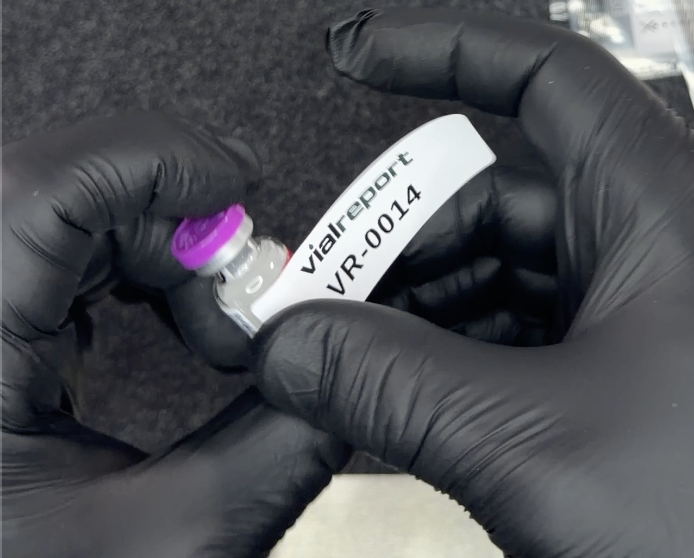
A code we assign to a sample, such as VR-0017, before it goes to the laboratory. The lab sees only the code, never the vendor name, so the result cannot be influenced by knowing whose product it is.
Blind purchase
Buying a product anonymously on the open market, with no vendor involvement and no advance notice. The vendor does not know a sample is being pulled, so they cannot select which unit we receive.
Bulk drug substance
An active ingredient used in compounding. Whether a given substance may be used is the subject of ongoing FDA review.
C-terminal
The other end of the chain, conventionally written last.
Cardiolipin
A lipid in the inner mitochondrial membrane, essential to how mitochondria function. Abnormalities in it underlie Barth syndrome, the approved indication for SS-31.
Case report
A published account of what happened to a single patient. It can flag a real safety signal, but on its own it cannot establish that the compound caused what was observed.
Category 1, Category 2, and Category 3
Interim FDA classifications for nominated bulk drug substances. Category 1 substances may be used in compounding while under evaluation; Category 2 substances have identified safety concerns and may not; Category 3 covers substances nominated without adequate supporting information. Removal from Category 2 is not an approval.
Cathelicidin
A family of host-defense peptides found across many species. Humans express only one, released by cleavage from a precursor protein.
Cationic peptide
A peptide carrying a strong net positive charge. Highly basic peptides adsorb readily to glass and plastic and can tail on standard reversed-phase columns, so a generic peptide method should not be assumed suitable without demonstrating retention, peak shape, and recovery for that specific molecule.
Chain of custody
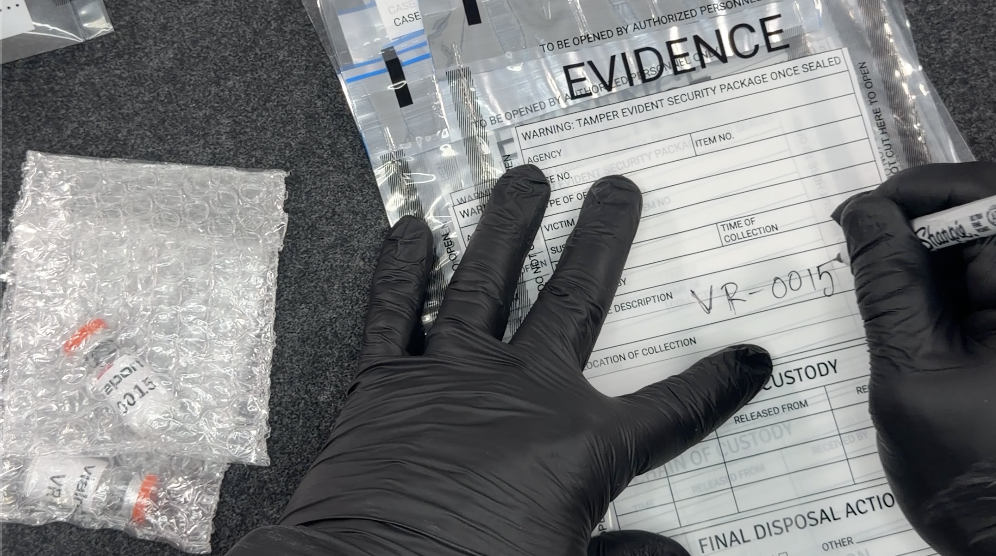
The documented, photographed record of a sample from the moment it arrives to the moment it is handed to the laboratory, including temperature readings at receipt, in storage, and at open.
Chromatogram
The output of a chromatography run: a graph of detector signal over time. Each peak is a component of the sample.
ClinicalTrials.gov and NCT number
The public registry of clinical trials and the identifier given to each one. A registered trial can be looked up, including whether it was completed or quietly abandoned.
COA
Certificate of analysis. A document stating what a laboratory found in a sample. A vendor-supplied COA is only as trustworthy as the laboratory that produced it and the batch it actually corresponds to.
COA Accuracy
How the numbers on a vendor's certificate compare to what our laboratory measured on the vial we bought. Content is compared to what the certificate itself claims, not to the vial label, because measured against label is Dose Accuracy and is already scored. Reported as a row on the scorecard, free on every report, and never part of the 0-to-100 score.
COA Integrity
Our umbrella term for two separate assessments of a vendor's certificate: COA Accuracy and Vendor Certificate Review. Both are reported beside the grade, never inside it, and they are kept under two names because they can point in opposite directions on the same vial.
Compound page
A reference page for one compound: what it is, what the published research has studied, and its regulatory status, plus every report we have published for it.
Compounding
The preparation of a customized medicine by a pharmacy for an individual patient. A different activity from manufacturing or from laboratory testing.
Counterion
The ion paired with a peptide in its salt form, commonly acetate or trifluoroacetate. Part of what makes salt form matter.
Cross-contamination
Material from one production run appearing in another, usually through shared equipment that was not adequately cleaned.
Cyclic peptide
A peptide whose chain is joined into a ring. It behaves differently from a linear peptide of the same sequence.
Dalton (Da)
The unit of molecular mass. A small peptide might be 900 Da; a protein can be tens of thousands.
Data
The paid tier that opens up the underlying measurements: purity figures, dose accuracy, and the full scorecard.
Diagnostic agent
A compound approved for use in a medical test rather than as a treatment. GHRP-2 is approved in Japan on this basis, which is narrower than it sounds.
Disulfide bridge
A bond linking two cysteine residues within a peptide, which affects its shape and can affect its measured mass.
Dose accuracy
How close the measured content is to the amount on the label, measured in both directions. Too little shortchanges the buyer. Too much is a dosing-accuracy failure, not a bonus.
Double-blind
Neither the participants nor the researchers know who received the compound until the study ends. It prevents expectation from shaping the result.
Dual agonist and triple agonist
A single molecule activating two or three different receptors. Tirzepatide is a dual agonist; retatrutide is a triple agonist.
Early clinical
Genuine human trials exist but are limited in size and scope, typically Phase 1 or Phase 2. The compound is not approved.
Endogenous
Produced by the body itself.
Endotoxin
A toxic component of the outer membrane of certain bacteria. It survives sterilization, so a sterile product can still carry endotoxin. This is why sterility and endotoxin are two separate tests.
Established human clinical
Substantial human trial evidence exists. Usually indicates the compound is approved somewhere for something, though not necessarily for the use it is marketed for.
Evaluated use
The specific use FDA put before an advisory committee for a substance. It is narrower than the substance itself, and a recommendation covering one evaluated use says nothing about any other.
Exogenous
Introduced from outside the body.
FDA-approved
A product the FDA has reviewed and authorized for a specific use. Approval attaches to a specific product and indication, not to a molecule in general. Material sold outside the approved supply chain is not the approved product, regardless of labeling.
Founding member
A capped early cohort with a rate locked for as long as membership stays active.
Fragment
A shorter piece of a larger peptide or protein. A fragment is not the same molecule as the parent, and research on one does not automatically apply to the other.
Free
Open access, no account. The grade, the verdict, identity, and any safety finding are always free. We charge for depth, never for the warning.
Free base
The compound without an associated salt. Distinguishing free base from a salt form matters whenever a mass or content figure is reported.
Ghrelin receptor (GHS-R1a)
The receptor ghrelin acts on. Ipamorelin, GHRP-2, GHRP-6, hexarelin and MK-677 all act here, which is why they are grouped together despite being chemically unrelated.
GHRH
Growth hormone-releasing hormone. The body's own signal telling the pituitary to release growth hormone. Sermorelin, CJC-1295 and tesamorelin are all analogues of it.
GIP
Glucose-dependent insulinotropic polypeptide. The other incretin. Tirzepatide acts on this and GLP-1 together.
GLP-1
Glucagon-like peptide-1. An incretin hormone affecting insulin secretion, stomach emptying and appetite. Semaglutide is an analogue of it.
Glucagon
A hormone that raises blood sugar, broadly opposing insulin. Retatrutide adds activity here on top of GLP-1 and GIP.
Glycosylation
Sugar groups attached to a protein. Varies with how the protein was produced, and complicates mass-based identification.
GMP
Good manufacturing practice. A regulatory framework for manufacturing quality. Frequently invoked in vendor marketing and rarely substantiated in this market.
Grade suppression
When identity is not confirmed, no grade is published at all: no letter and no number. A vial that is not the labeled compound has nothing coherent to grade, so the measurements are published as raw values instead.
Graded sample
A sample that received a quality grade. Samples that failed identity are excluded from this count, because they were never gradeable.
GRF 1-29
Another name for the first 29 amino acids of GHRH, the portion carrying its activity. Sermorelin is that sequence unmodified; Mod GRF 1-29 is a modified version of it.
Growth hormone (GH)
A hormone released by the pituitary that drives growth and influences metabolism and body composition. Many compounds in this library act on the systems controlling it rather than being it.
GSH and GSSG
The reduced and oxidized forms of glutathione. Two reduced molecules join to form the oxidized disulfide, and the two interconvert, so a material can shift between them after manufacture without anything having gone wrong. A single purity figure does not describe a material that exists in two interconverting forms; a meaningful result states which form was quantified.
Half-life
How long it takes for half of a compound to clear the body. It determines how often something has to be given, and it is one of the clearest differences between compounds sold under the same name.
Heavy metals
Elemental impurities such as lead, arsenic, cadmium, and mercury, which can be introduced during synthesis or from equipment.
Heptapeptide
A peptide seven amino acids long.
HPLC
High-performance liquid chromatography. The standard method for separating the components of a sample so each can be measured. It is how purity and content are determined.
HPLC-RTM
Identity confirmation by retention-time matching against a reference standard. This is the standard identity method on most accredited peptide panels. It is a consistency check rather than a definitive mass-based confirmation.
ICP-MS
Inductively coupled plasma mass spectrometry. The standard method for measuring heavy metals.
Identity gate
Identity is checked before anything else, and it decides whether a grade appears. It is not scored, because a compound either is or is not what the label says.
IGF-1
Insulin-like growth factor 1. A hormone made mainly by the liver in response to growth hormone. Much of what growth hormone does downstream, it does through IGF-1.
Immunoassay
A test using antibodies to detect a specific substance. The fentanyl screen is an immunoassay.
In vitro
Research done in cells or tissue in a dish, outside a living organism. A result in vitro is a starting point, not evidence that something works in a person.
In vivo
Research done in a living organism. In this market that usually means rodents.
Incretin
A gut hormone released after eating that influences insulin release. GLP-1 and GIP are the two that matter in this library.
Independent replication
A finding reproduced by researchers unconnected to the group that first reported it. Regulators and drug developers weight replication more heavily than the original finding, and it is scarce across much of the research-peptide literature.
Indication
The specific condition a drug is approved to treat. Approval attaches to an indication, not to a molecule in general.
Intermediate endpoint
A measure believed to predict a real clinical benefit, used as a stand-in when the real outcome would take too long to observe.
Investigational
In clinical trials but not approved. An investigational compound is generally available only to trial participants.
ISO/IEC 17025
The international standard for testing laboratory competence. Accreditation means a laboratory's methods and quality systems have been independently assessed.
Isoform
One of several versions of a protein produced from the same gene. Related but not identical, and research on one does not automatically apply to another.
Label claim
What the vendor states is in the vial, for example "10 mg". It is the reference point that measured purity and content results are compared against.
LAL
Limulus amebocyte lysate. The standard assay for detecting bacterial endotoxin.
LC-MS
Liquid chromatography combined with mass spectrometry. Separates a sample and then measures the mass of what comes out. A stronger identity method than retention time alone, because it measures the mass of the molecule itself rather than its behavior on a column.
LC-MS confirmed
The label we use when molecular weight has been verified by mass spectrometry. It is the stronger of our two identity methods, and confirmed is the only place we use that word about identity.
Limit of detection
The lowest amount an assay can reliably detect. "Not detected" means below this limit, not that the substance is absolutely absent.
Lipogenesis
The formation of stored fat. The opposite side of the same balance.
Lipolysis
The breakdown of stored fat. Compounds marketed for fat loss are usually described as increasing it.
Lyophilized
Freeze-dried into a powder. Most research peptides ship this way because dry material is more stable than material in solution.
Marketing authorization
The equivalent of FDA approval granted by another country's regulator. Approval elsewhere is not approval here and does not transfer.
Mass spectrometry
A technique that measures the mass of molecules in a sample. Stronger evidence of identity than retention time, because it measures the molecule itself rather than its behavior on a column.
Matches
The COA Accuracy outcome when the certificate's purity and content figures both agree with our measurement, within tolerance. A certificate claiming less than we measured also reads as Matches, because a vendor is never marked down for being conservative about their own product.
Matches (in-house)
The same COA Accuracy outcome as Matches, on a certificate from the vendor's own laboratory rather than an outside one. The distinction is recorded because it describes the document, not because it changes the result.
Melanocortin receptor
A family of receptors including MC1R, which drives pigmentation, and MC4R, involved in appetite and sexual function. A compound acting on several of them non-selectively produces effects beyond the one being sought.
Molecular weight
The mass of a molecule, given in Daltons. Because different compounds have different masses, it is one of the clearest ways to tell them apart.
Myostatin
A protein that limits muscle growth. Blocking it has been a long-standing target of interest, and it is what follistatin is marketed on.
N-terminal
One end of a peptide chain, conventionally written first. Modifications at this end are common and produce a different molecule.
Net peptide content
The mass of actual peptide in a vial, excluding salts, water, and other non-peptide material. Frequently lower than the gross powder weight, and the number that matters.
Never-revise
We do not retest a failing result at a vendor's request, and we do not quietly amend a published report. Retests happen at our discretion and the original result stays on the record.
New Drug Application (NDA)
The submission a company makes asking the FDA to approve a drug. Filing one is not approval.
No human data
A compound with no published human studies at all. The available evidence comes entirely from animal or cell-culture work.
Nomination and withdrawal
A substance is nominated for the compounding bulk drug lists, and the nomination can be withdrawn before a decision is reached. Withdrawal removes it from the list without the FDA having found it safe or eligible.
Non-standard amino acid
A building block outside the twenty the body normally uses, introduced deliberately to resist breakdown. It also gives a molecule a distinctive analytical signature.
Nonapeptide
A peptide nine amino acids long.
Nonproprietary name
The official generic name assigned to a substance, distinct from the research-market name it is commonly sold under. The same molecule may appear as pralmorelin and GHRP-2, thymalfasin and thymosin alpha-1, ibutamoren mesylate and MK-677, or emideltide and DSIP. Regulatory documents use the nonproprietary name, which is often not the name on the vial.
Not assessable
The COA Accuracy outcome when identity was not established, so the certificate describes a different substance than the one measured and its claims cannot be compared.
Not verifiable for this vial
The COA Accuracy outcome when no certificate tied to this batch was available, or the certificate provided covers a different batch or a different compound.
Open-label extension
A continuation phase after the controlled part of a trial, where everyone knows they are receiving the compound. Useful for long-term safety, weak as efficacy evidence, because the blinding is gone.
Orally active
Survives digestion well enough to work when swallowed. Almost no peptides do, which is why MK-677 being oral is a real distinction rather than a marketing one.
Overfill
More active compound in the vial than the label claims. Because dosing is calculated from the label, an overfilled vial delivers a stronger dose than intended on every use.
Overstated
The COA Accuracy outcome when a certificate states a higher purity or a higher content than we measured. The size of the gap is always shown. We do not publish a severity ladder, because there is no analytical basis for a cutoff separating a large gap from a very large one, and the number tells you more than any adjective we could attach to it.
PCAC
The Pharmacy Compounding Advisory Committee. An FDA advisory body that reviews substances nominated for compounding use. Its recommendations are advisory, not approvals.
PEGylation
Attaching polyethylene glycol chains to a molecule, usually to make it last longer. Because the chains vary in length and attachment point, two products labeled the same way can be genuinely different molecules.
Pentapeptide
A peptide five amino acids long.
Peptide
A chain of amino acids. Shorter than a protein, though the boundary is a convention rather than a rule.
Pharmacodynamics
What the compound does to the body. The other half of the pair.
Pharmacokinetics
What the body does to a compound: how it is absorbed, distributed, broken down and cleared.
Phase 1
The first human trials. Small, and focused on safety and how the body handles the compound rather than on whether it works.
Phase 2
Human trials testing whether the compound does anything and at what dose, usually in a few hundred people at most.
Phase 3
Large human trials designed to demonstrate effectiveness against a comparison group. The stage regulators base approvals on.
Phase 3 clinical (investigational)
Advanced human trials are under way or have reported results. The compound remains unapproved and is generally available only through the trial itself.
Pituitary
A small gland at the base of the brain that releases growth hormone and several other hormones on instruction from the hypothalamus.
Placebo-controlled
Some participants receive an inactive substitute, so the effect of the compound can be separated from the effect of simply being treated.
Potency
Commonly confused with purity. Potency is about how much active compound is present; purity is about what proportion of the material is the right molecule. A vial can be highly pure and badly underfilled.
Preclinical
Evidence is predominantly from animal studies. Any human data is limited to small uncontrolled pilots. This describes the majority of compounds sold in research markets.
Preclinical research
The work done before human trials begin: cell culture and animal studies. This is the stage most peptide marketing draws its claims from.
Precursor
A longer molecule the body processes into the final active one. Material labeled by precursor number may not correspond to the processed form actually being described.
Primary endpoint
The single outcome a trial was designed in advance to measure. A trial that misses its primary endpoint has failed, whatever else it happened to find.
Proof
The tier that includes the raw evidence behind a report, including the laboratory certificate itself.
Propeptide
The portion removed from a precursor during processing. Not the active molecule.
Publish-fails policy
We publish every result we commission, including the poor ones. A tester who only publishes good news is running a marketing program.
Purity
The percentage of the peptide-related material in a vial that is the target compound. It says nothing about how much is in the vial, and nothing about safety.
Randomized controlled trial
A study where participants are assigned by chance to receive the compound or a comparison. Randomization is what stops a result being explained by who chose what.
Receptor agonist
A molecule that binds a receptor and activates it.
Recombinant
Produced by engineered cells rather than chemical synthesis. The method matters here: much of the clinical evidence in this market was generated with recombinant full-length protein, not the synthetic fragment being sold.
Reconstitution
Adding liquid to a lyophilized powder to return it to solution.
Recovery
Measured content divided by label claim, expressed as a percentage. A 9.2 mg result on a 10 mg label is 92% recovery.
Reference standard
A certified sample of a known compound that the laboratory compares against. Every identity confirmation is only as good as the standard it was compared to.
Research use only
A label indicating a product is not intended for human use. The label does not by itself determine how a product is regulated; what matters is the seller's actual intended use.
Residual solvents
Solvents left over from the manufacturing process that were not fully removed.
Retention time
How long a component takes to travel through the chromatography column. Comparing a sample's retention time to a reference standard is one way to check identity.
Retention-time consistent
The label we use when a sample elutes with a certified reference standard by HPLC. It is our standard identity check and a consistency check rather than a mass-based confirmation, so we never describe it as confirmed. Where both methods are run and disagree, the mass-based result governs and the disagreement is published.
RP-HPLC
Reversed-phase HPLC. The most common configuration for peptide analysis.
Safety-tested denominator
Safety assays are not run on every sample, so safety failures are counted against the number of samples actually tested for safety, not against the total. That is why a vendor page can show a different count for quality and for safety.
Salt form
Peptides are usually supplied as a salt rather than as the pure compound. The salt adds mass, so a milligram figure can mean different things depending on which form was measured.
Satellite cell
A muscle stem cell that activates in response to damage and contributes to repair. Central to the claims made for MGF.
Secretagogue
A compound that prompts the body to release its own hormone rather than supplying that hormone directly. A growth hormone secretagogue makes the pituitary release growth hormone; it is not growth hormone.
Selectivity
How narrowly a compound acts on its intended receptor rather than others. A more selective compound produces fewer effects outside the one being sought.
Sequence
The specific order of amino acids in a peptide, usually written as a string of letters. It defines the molecule.
Shipped-from origin
Whether a vendor ships domestically or from outside the United States. We record it because it is a meaningful variable in product condition on arrival.
Signal
Market-level aggregate data across vendors and compounds, rather than individual reports. Not yet available.
Somatotroph
The specific pituitary cells that make and release growth hormone.
Splice variant
A different version of a protein produced from the same gene. Related to the parent but not identical.
Sterility
The absence of viable microorganisms. A sterility test cannot detect the presence of sterility; it can only fail to detect growth, which is why results are reported as no growth detected rather than as a pass.
TB-500
A short synthetic peptide, roughly 889 Da, corresponding to the actin-binding region of thymosin beta-4 rather than the full-length molecule. The two are routinely sold and cited interchangeably and are not the same compound.
Telomerase
An enzyme that extends telomeres, the protective caps on chromosomes. The most cited claim about Epitalon rests on telomerase activity observed in cell culture that has not been widely reproduced.
Testing roadmap
A public view of what is in our pipeline and at what stage: requested, in lab, report compiling, or published.
Tetrapeptide
A peptide four amino acids long.
TFA
Trifluoroacetic acid. A common counterion left over from peptide purification.
Thymosin beta-4
A naturally occurring 43-amino-acid peptide, roughly 4,963 Da, expressed in nearly all nucleated cell types, and the molecule behind most of the published research associated with the name TB-500.
Topline results
A sponsor's early public summary of a trial, released before the full data is published. It is the company describing its own result.
Tripeptide
A peptide three amino acids long. KPV is one.
Unapproved
Not reviewed or authorized by the FDA for any use. Most compounds sold in research markets are unapproved.
Underfill
Less active compound in the vial than the label claims.
Unverified status
Where we have not independently verified a substance's status on the FDA bulk drug substances lists, we publish no status claim at all and say so plainly. We do not hedge a claim we cannot support. Where we have verified that a substance is absent from the lists, we state that as a positive fact rather than leaving a silence.
USP <71>
The United States Pharmacopeia chapter defining sterility testing. Requires an unopened vial, which is why a full safety panel needs more product than a purity test.
USP/NF monograph
A published quality standard for a substance in the United States Pharmacopeia. No monograph means there is no agreed specification for what the material should be.
UV detection at 214 nm
The wavelength commonly used to detect peptides in HPLC, chosen because peptide bonds absorb strongly there.
Vendor Certificate Review
Whether a certificate is a trustworthy document for the vial in our hands, assessed on four checks: provenance, batch and lot match, recency, and internal consistency. It states facts about the document and makes no claim about anyone's intent. Reported below the scorecard and never part of the score.
Vendor page
A page collecting every report we have published for one seller, with three separate figures: an average quality grade, an identity failure count, and a safety failure count.
Stay current
Free. We email when results are in, and nothing else.
Powered by MailerLite. No spam. Unsubscribe anytime.